Reel Opportunities

Storyboard Artist

What does a Storyboard Artist do?

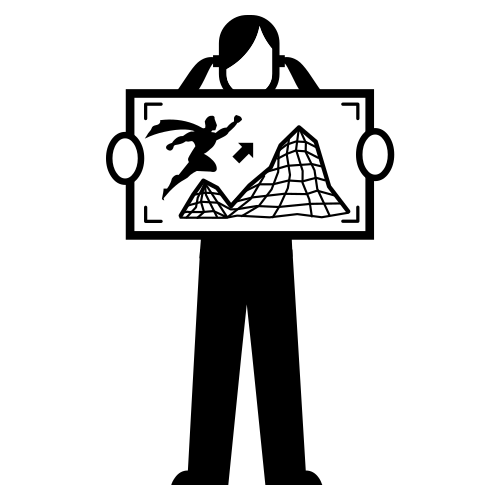
A Storyboard Artist visualizes a story for film or TV, and creates frame-by-frame sketches. Storyboard Artists may use photos, or they might illustrate the images themselves. They work under the supervision of the film’s Director and/or Cinematographer (DoP) to illustrate what the movie will eventually look like – sort of like a comic book version of the film that shows all the camera movements, angles and shots.

The purpose of storyboards is to help the Director, Cinematographer and crew plan how to set up certain shots. They can also sometimes be used by Producers as a way to illustrate the Director’s vision in a presentation to funders or other supporters. Animated projects are often pitched on the basis of storyboards alone (that is, a screenplay may not be written until later), and Storyboard Artists continue to work throughout the production to develop particular sequences. As a sequence is edited, the Director, Storyboard Artist and creative team may need to rework the sequence.

What's a Storyboard Artist good at?
  • Drawing

    Have excellent drawing skills and be able to produce artwork in a range of styles

  • Listening

    Be able to listen and execute the visions of the Director, Writer and creative heads

  • Storytelling

    Be able to communicate a narrative well

  • Learning by watching and asking

    Observe what’s happening in your department and company, take initiative, ask questions at appropriate times

  • Watching films

    Have a passion for the medium and a love of the industry

  • Computer software knowledge

    Many Storyboard Artists choose to develop their frames using readily available storyboarding software

Who does a Storyboard Artist work with?

Once the script has been broken down into a ‘shooting script’, Storyboard Artists work with the Director, and sometimes the Director of Photography and/or the Writer to create a visual rendering of the proposed frames and shots.

How do I become a Storyboard Artist?

The most important thing when applying for roles in storyboarding is to demonstrate good drawing skills. You need to show storytelling skills and an understanding of film. Many Storyboard Artists have a degree but you don’t necessarily need one as long as you have a strong portfolio and can show your experience. In some companies you can move into being a Junior Storyboard Artist from being a Production Assistant.

Educational requirements: Any art school with an animation or illustration department is a solid place to build fundamental skills. The essential part is strong illustration skills.

Develop Art and Illustration Skills: Regularly practice drawing and observing how people and things around you move and look. Carry a sketchbook with you.

Build a portfolio: Learn how to show story sequences cut together in an animatic form. Start creating work that you can show to admissions tutors or employers.

More tips

For more tips on finding job opportunities, lists of training programmes, and other great resources, check out our Career Resources page.

Professional Organizations Associated With This Role

Click on your region to find out which professional organizations in your area are associated with this career and watch videos to learn more about them.

This position is represented by the following unions/guilds in your selected region.

Sorry, we couldn’t find a professional organization associated with this role in the region you selected.

Our Partner, ScreenSkills UK is the industry-led skills body for the UK screen industries. For further information, www.screenskills.com.
Profiles and profile icons © 2022 ScreenSkills Limited. All rights reserved. No part of this publication may be reproduced without the permission of the copyright owner.
Job Profile Design by Dave Gray. Based on an original concept by Ian Murphy/Allan Burrell.

Reel Opportunities

Production Designer

What is a Production Designer?
What does a Production Designer do?

Production Designers create the way a film or TV drama looks. Films can be set in any number of places; a Victorian orphanage, a Caribbean cruise ship, or another planet, for example. They are an artistic jack-of-all-trades and a confident leader who manages the entire art department. They work with all the other visual departments, costume, lighting, visual and special effects, and graphic design. They help create the visual world in which the story is set.

Production Designers start with the script. Researching and collaborating with the Director, Director of Photography and other heads of department, they imagine the screenplay visually. They draw sketches showing mood, atmosphere, lighting, composition, colour and texture, which are given to the Art Director to develop.

The Production Designer is also in charge of hiring and managing the art department, which can be one of the biggest departments on a film crew. They then work with other art department members to draw up a budget. They prioritize the work schedule and allocate the management of finances to team members performing different tasks.

What's a Production Designer good at?
  • Creativity

    Visualize the whole look of a film or TV drama, starting with words on a page

  • Art

    Draw by hand to scale, do technical drawings and computer-aided design

  • Design

    Understand colour theory, know the history of architecture and interior design

  • Knowledge of Photography

    Understand cameras, lenses and lighting and their effect on a film’s look and mood

  • Organization

    Manage budgets, draw up schedules, prioritize and meet deadlines

  • Communication

    Share the vision with a wide number of different people and keep a team working together well

Who does a Production Designer work with?

Set Decorator
The Set Decorator is responsible for the decoration of a set, including furnishings and all objects that are on view.

Production Buyer
Before the start of shooting, Production Buyers prepare orders for props.

Art Director
On big productions, Art Directors may start work months before shooting starts. They analyze a script to identify all the props or special items that will be needed and find cost-effective creative solutions to construction and decorating problems.

Assistant Art Director (first assistant, second, third)
Assistant Art Directors’ responsibilities vary depending on the size of the production. They may help the Art Director with research, surveying locations, model making or producing sets. On large productions with multiple sets, an Assistant Art Director will take responsibility for some of the smaller sets and manage the cleanliness and props for that set. Assistant Art Directors also sketch ideas, refine them, and work on 3D models.

Concept Artist
Big studio productions usually hire a number of concept artists to design specific elements, such as fantasy creatures. Concept Artists may analyze source material and work on illustrations that are both striking and accurate to be presented to the Producer, Director, and FX Supervisors. Many Concept Artists start their careers as graphic artists or illustrators before moving into the screen industries.

Set Designer
Set Designers provide hundreds of technical drawings that serve as a template for the construction department. Drawings are often still produced by hand, but computer-aided design software (also known as CAD software) is also used.

Production Assistant
Production Assistants usually start work in the early stages of pre-production and can be specifically assigned to the art department. This is an entry-level position and tasks vary.

How do I become a Production Designer?

As with many creative fields, there is no set way of becoming a Production Designer. Degrees in graphic design, theatre, architecture, or art, however, will give you a solid background in some of the key skills you’ll need to get into the industry—and can provide you with valuable industry connections. Courses in woodwork and set construction at your local college can be valuable to gain experience in building and design.

Most Production Designers have worked in the art department for many years. Aim to start as a Production Assistant and work your way up through the ranks outlined above.

More tips

For more tips on finding job opportunities, lists of training programmes, and other great resources, check out our Career Resources page.

Professional Organizations Associated With This Role

Click on your region to find out which professional organizations in your area are associated with this career and watch videos to learn more about them.

This position is represented by the following unions/guilds in your selected region.

Sorry, we couldn’t find a professional organization associated with this role in the region you selected.

Our Partner, ScreenSkills UK is the industry-led skills body for the UK screen industries. For further information, www.screenskills.com.
Profiles and profile icons © 2022 ScreenSkills Limited. All rights reserved. No part of this publication may be reproduced without the permission of the copyright owner.
Job Profile Design by Dave Gray. Based on an original concept by Ian Murphy/Allan Burrell.
Reel Opportunities

Costume Designer

What does a Costume Designer do?

A Costume Designer is a person who designs the look of the costumes and wardrobe for all of the cast on a film or TV show.

Costume is at the core of a film or TV production. As well as contributing to the overall look, specific clothing helps actors feel emotionally connected to the character they are playing.

Costume Designers design and create or purchase all costumes for the cast. The role of the Costume Designer is to create the characters’ outfits and balance the scenes using texture and colour. They may sew and construct the costumes from scratch, or source existing clothing that suits the look of the film. The Costume Designer may also collaborate with the hair and makeup departments.

They start by working with Directors, Producers, Writers, the Production Designer, and hair and makeup departments to help give the production a look that supports the storytelling. They research, sketch, and draw mood boards of characters and clothes to communicate the style.

They then break down the script, working out what they need to create or acquire. Working within tight budgets and deadlines, they recruit a team, organize a schedule of purchases and ensure the costumes are created on time for fittings. With the help of the team they schedule fittings and take photographs. These are then approved by the Producer and Director. They are also responsible for ensuring all materials used in the development or creation of the various costumes meet safety standards (for example, breakaway materials for easy on and off) and are within budget.

What's a Costume Designer good at?
  • Dressmaking and Tailoring

    Draw, sew, make and source clothes, including fabrics and accessories

  • Styling

    Understand the director’s vision, know what that means for the costumes, know what styles suit different people best and create the right looks with flair and creativity, have an eye for detail

  • Costume History

    Know contemporary fashion and clothing design through the ages, be able to research using books, museums and the internet

  • Storytelling

    Understand how a story can be told through garments and colour palette

  • Making Clothes

    Have an in-depth knowledge of all aspects of garment production

  • Organization

    Break down a script into costume requirements, schedule the costume production, manage the team and the budget

  • Communication

    Share the vision of the costume design with team members, listen to actors and respond to their needs, be trusted, and have good relationships with designers, PR (public relations), and brands who may supply clothing in current styles, as well as hair and make-up artists

Who does a Costume Designer work with?

Costume Supervisor or Background Costume Supervisor
Supervisors oversee the day-to-day use of the wardrobe on set and plan for the coming days or weeks. This includes organizing schedules, transport and checking continuity. They may be required to organize and arrange costume purchases. A very important role of the costume supervisor is to oversee the washing and repair of the costumes, as they are often heavily used throughout the day and start to wear and tear. Costume Designers spend most of their time in their own department, creating, sourcing, adjusting and maintaining outfits.

Costume Design Assistant
Costume Design Assistants work with Costume Designers to break down the script and assess the costume needs of every character. They research costume styles, designs and construction methods using the internet, archives and museums. They work on the department budget, estimating costs of staff and resources, can be involved in sourcing and buying costumes, accessories and fabric swatches. They may oversee fittings or be given responsibilities for taking specific actors’ measurements. They may also be in charge of costuming the supporting artists under the guidance of the costume designer.

Costume Maker/Sewer
Costume Makers create the garments. Starting with the designer’s specifications, Costume Makers cut the fabric and sew the costumes. Sometimes they make a rough version first. It’s a creative role because it involves interpreting the vision. Costume makers also fit the costumes on the actors and alter the garments as required.

How do I become a Costume Designer?

Costume designers typically start as costume trainees and work their way up through the ranks of the department outlined above. Some have experience working with costumiers and others come from theatre or dressmaking.

Get an internship: Internships are jobs with training, so they are a great opportunity to earn as you learn. It might be worth looking for a job as an apprentice in an industry that uses similar skills, such as being a tailor for a clothing designer or tailoring company.

Build a portfolio: Create a portfolio of the work you have done. This could include design sketches, photos of costumes you made, or past work experience in the field. This will be used to show off your work to new job opportunities.

Meet people in the industry: Reach out into the industry and express your interest. You can meet some people you could potentially shadow and create a working relationship with.

More tips

For more tips on finding job opportunities, lists of training programmes, and other great resources, check out our Career Resources page.

Professional Organizations Associated With This Role

Click on your region to find out which professional organizations in your area are associated with this career and watch videos to learn more about them.

This position is represented by the following unions/guilds in your selected region.

Sorry, we couldn’t find a professional organization associated with this role in the region you selected.

Our Partner, ScreenSkills UK is the industry-led skills body for the UK screen industries. For further information, www.screenskills.com.
Profiles and profile icons © 2022 ScreenSkills Limited. All rights reserved. No part of this publication may be reproduced without the permission of the copyright owner.
Job Profile Design by Dave Gray. Based on an original concept by Ian Murphy/Allan Burrell.
Reel Opportunities

Costume Supervisor

Also known as: Wardrobe Supervisor

What does a Costume Supervisor do?

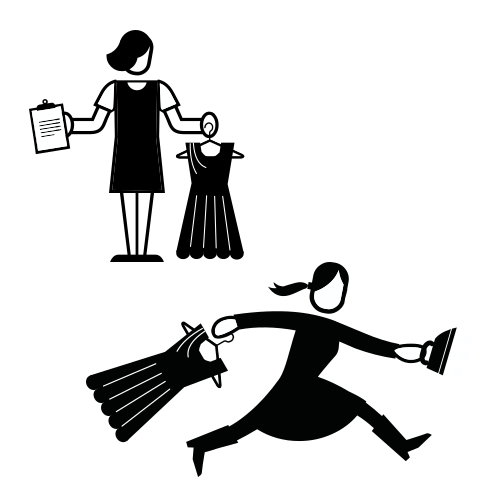
The Costume Supervisor is the head of the costume department. They oversee all aspects of the department including management of dressers, designers, assistants and fitters. Other duties include buying wardrobe and costume pieces, designing and repairing costumes.

Costume Supervisors keep everything shipshape in the ‘costume or wardrobe department’ and thrive on being organized. Working to the Costume Designer’s plans, they coordinate the work of the department, work out what clothes and accessories need to be made, hired or bought, what staff are needed and where. They also organize storage and supervise the tasks that need doing to ensure all work is done to schedule and budget.

Costume Supervisors work with the Costume Designer to ensure costumes or outfits are of the standard they require, ready and prepared in time for fittings, rehearsals, and shooting. During filming, they supervise continuity of outfits, the cleaning, maintenance and any repairs or adjustments. When filming is over, they supervise any cleaning, repairing and returns.

What's a Costume Supervisor good at?
  • Organization

    Schedule the costume production or hire, maintenance, repairs and adjustments, oversee the department budget and the petty cash

  • Leadership

    Manage large teams of people with different skills and responsibilities, deliver costumes and outfits when required, meeting department and production deadlines

  • Communication

    Work well with others and have good relationships with designers, PR (public relations) and brands who may supply clothing or costumes, explain clearly to staff what’s expected of them

  • Dressmaking and Tailoring

    Draw, sew, make and source clothes, including fabrics and accessories

  • Knowledge of Design

    Be aware of the history of design and costume, and have an understanding of colour, pattern and texture

Who does a Costume Supervisor work with?

A Costume Supervisor typically spends most of their time in their own department, overseeing the creating, sourcing, adjusting, maintenance, cleaning and repair of outfits. They work closely with the Costume Designer to ensure the team they manage makes the costumes or outfits the designer wants and will often work with the same designer on all their big productions. They may work closely with the hair and make-up team, particularly if wigs are required.

Costume Supervisors have regular updates with the production management team regarding budgets and schedules. They have contact with members of editorial and production to ensure all needs are being met.

How do I become a Costume Supervisor?

Costume Supervisors usually start out working as trainees or assistants in the costume department and work their way up. A background in fashion or costume production is helpful.

More tips

For more tips on finding job opportunities, lists of training programmes, and other great resources, check out our Career Resources page.

Professional Organizations Associated With This Role

Click on your region to find out which professional organizations in your area are associated with this career and watch videos to learn more about them.

This position is represented by the following unions/guilds in your selected region.

Sorry, we couldn’t find a professional organization associated with this role in the region you selected.

Our Partner, ScreenSkills UK is the industry-led skills body for the UK screen industries. For further information, www.screenskills.com.
Profiles and profile icons © 2022 ScreenSkills Limited. All rights reserved. No part of this publication may be reproduced without the permission of the copyright owner.
Job Profile Design by Dave Gray. Based on an original concept by Ian Murphy/Allan Burrell.